Pattachitra: The Sacred Scroll Paintings of Raghurajpur
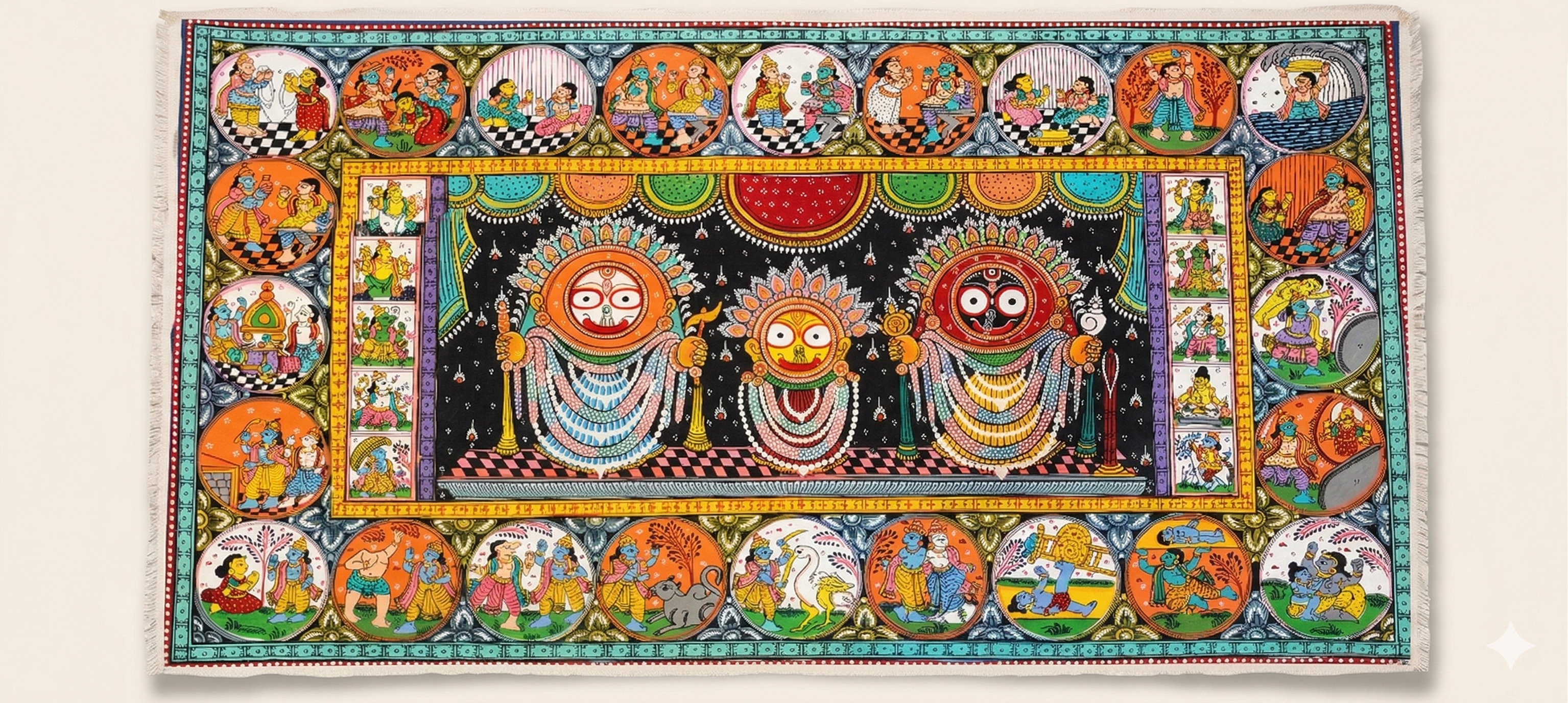
In the heritage craft village of Raghurajpur, near Puri in Odisha, every house is a studio. Children grow up watching their parents mix pigments from conch shells and lamp soot, listening to the stories of Lord Jagannath painted onto cloth canvases that have served as portable temples for centuries. This is where Chitranjan Swain learned to paint — not from a textbook, but from the living tradition of his family.
What is Pattachitra?
The word Pattachitra comes from Sanskrit: patta meaning cloth or leaf, and chitra meaning painting. It is one of the oldest visual art traditions in India, with documented origins going back over a thousand years — though practitioners in Raghurajpur believe it is far older, a form of devotional offering that predates written history in the region.
The paintings are devotional in nature — narratives of the Jagannath tradition (the Lord of the Universe), stories of Krishna Leela, scenes from the Ramayana and Mahabharata. They were originally created as calendar art for the Puri Jagannath Temple, serving pilgrims who could not afford stone sculptures as souvenirs of their pilgrimage. Today, the finest examples are exhibited at national museums and collected by interior designers and cultural institutions around the world.
Raghurajpur: The Village That Lives Its Art
Raghurajpur is 14 kilometres north of Puri, a small village that has been designated a heritage crafts village by the Crafts Council of India. It is extraordinary in one specific way: virtually every family in the village is a practising artist. The walls of the houses are themselves painted. Children learn to draw before they learn to write.
The village is also home to practitioners of other crafts: palm leaf engraving (known as Talapatra Chitra), stone carving, Tussar silk painting, and wooden toy-making. But Pattachitra remains the prestige art form — the one that requires the longest apprenticeship and commands the deepest cultural respect.
Chitranjan Swain: Five Generations of Devotion
Chitranjan Swain was born into a family of chitrakars — the traditional term for painter-priests who create Pattachitra. His grandfather was a master artist. His father carried that tradition forward. Chitranjan began learning at seven, initially by watching, then by being allowed to fill in backgrounds, and gradually by taking on increasingly complex narrative panels.
Today, he works with his mother, who handles the painstaking canvas preparation while he concentrates on the painting itself. It is a partnership that mirrors the way the craft has always been organised — as a family endeavour, where every hand contributes to the final work.
"When I paint Jagannath, I am not just making art," Chitranjan says. "I am offering my prayer through my hands." This is not a metaphor — it is the foundational philosophy of the tradition. The chitrakar is not an artist in the Western sense of an individual expressing personal vision. He is a vehicle for sacred stories, a craftsman-priest whose skill is in service of devotion.
The Process: From Raw Materials to Sacred Image
The making of a single Pattachitra panel is a multi-week process, sometimes stretching to three months for large, complex works. Every stage is done by hand, using materials that have remained unchanged for centuries.
Canvas preparation begins with layering cotton cloth with tamarind seed paste — a natural adhesive. Multiple layers are built up, dried, and then coated with a fine mixture of chalk powder and gum to create a smooth, stiff surface. This patta (prepared canvas) has a subtle texture and warmth that cannot be replicated on paper or synthetic materials.
The colours are entirely natural and sourced from minerals and organic materials:
- White from powdered conch shells
- Red from hingula (cinnabar) stone
- Yellow from haritala (orpiment mineral)
- Blue from indigo plant extract
- Black from lamp soot (kajal)
- Green from mixed minerals
The painting itself begins with a fine brush — traditionally made from the tip of a mouse's tail or fine squirrel hair — used to draw the outline figures. These outlines are drawn freehand, without preliminary sketching, a skill that takes years of muscle memory to develop. The figures follow strict iconographic conventions: the position of the hands (mudras), the arrangement of figures in relation to each other, the symbolic objects each deity carries — all of this is codified in a tradition passed down through oral teaching and close observation.
Once outlined, the colours are filled in layer by layer. The signature border of Pattachitra — typically a repeated pattern of creepers, flowers, and geometric forms — frames the central narrative and is often the most intricate part of the work.
Why Designers and Collectors Love Pattachitra
For architects and interior designers working on high-end residential or hospitality projects, Pattachitra offers something increasingly rare: an artwork that is simultaneously ancient and contemporary. The strong graphic quality of the paintings — bold outlines, flat planes of rich colour, intricate patterning — translates exceptionally well at scale.
Large Pattachitra panels — commissioned at 4 to 6 feet — have been used as focal walls in luxury hotel lobbies, as statement pieces in private collector residences, and as bespoke installations in cultural centres. The natural pigments do not fade with exposure to normal indoor light, and the prepared cloth canvas is durable. A well-made Pattachitra, properly framed, will outlast almost any other form of artwork in an interior.
Beyond aesthetics, there is the question of provenance. When a designer specifies a Chitranjan Swain Pattachitra, they are placing a work by a named master artist — fifth generation, from the pre-eminent craft village of his tradition — into a project. That story becomes part of the space itself.
Commissioning a Pattachitra
We work directly with Chitranjan to commission works for specific projects. Lead times range from four to sixteen weeks depending on the scale and complexity of the commission. We handle all logistics from Raghurajpur to the project site, including archival framing consultation.
If you are working on a project and would like to explore how Pattachitra could work within it, get in touch through our enquiry form. We will connect you directly with Chitranjan to discuss the narrative, scale, and placement.